Table of Contents
How to find real estate syndication deals as a passive investor is largely a relationship question, not a search-engine question. Most credible multifamily syndication deals never appear on public aggregator sites — they surface through the sponsor's own investor list, through referrals from existing LPs, through educational content (newsletters, podcasts, mini-courses) that brings prospective investors into a 1:1 conversation, and through professional networks like LinkedIn where operators and LPs find each other organically.
That structural reality is one of the most important things for a new LP to internalize before deploying capital. The discovery routes that produce the most credible opportunities are also the slowest — building relationships with sponsors, getting onto investor lists, and waiting for the right deal to land in front of you. The fastest discovery routes — crowdfunding platforms, aggregator sites, social-media deal posts — produce a far higher proportion of weak deals and weak sponsors per opportunity reviewed, because the platforms themselves filter for sponsor marketing budget rather than sponsor quality.
This guide walks through how the discovery channels actually break out, what to evaluate at the sponsor level before you evaluate the deal itself, the financial and structural mechanics every LP should understand (including a counterintuitive point about sponsor co-invest), and the practical due-diligence framework for moving from a discovered deal to a subscribed one.
Key Takeaways
- Most credible multifamily syndication deals surface through direct relationships — sponsor investor lists, referrals from existing LPs, organic search, and LinkedIn — not through public crowdfunding aggregators. Crowdfunding sites are informal and tend to surface deals that did not subscribe out through the relationship channel.
- Sponsor diligence matters more than deal diligence. Track record on full-cycle outcomes, lender relationships, operational discipline (verifying actuals vs. accepting broker pro formas), and reporting transparency predict outcomes better than the headline projected IRR.
- Sponsor co-invest is one of the most misunderstood metrics: lenders typically require sponsors to hold liquidity equal to ~10% of the loan balance to qualify for new debt and remain compliant on existing loans, so a near-zero cash co-invest is often a structural lender constraint, not a misalignment signal. The right LP-side question is about earned promote and asset-management alignment, not just cash in.
Understanding Real Estate Syndication
Real estate syndication is the structure that lets a group of passive investors pool capital alongside an experienced operator to acquire a property that none of them could (or would want to) buy individually. The operator — typically called the sponsor or general partner (GP) — sources the deal, structures the debt, executes the business plan, and reports to the limited partners (LPs) who provided the bulk of the equity. The LPs receive a pro-rata share of cash flow and appreciation in exchange for putting up most of the capital and accepting that they have no day-to-day decision-making authority over the asset.
The structure works for the LP because it solves a real problem: the typical accredited investor wants the cash flow, depreciation benefits, and inflation hedging that real estate produces, but does not want to be a landlord, does not want to source and underwrite deals in their spare time, and does not want to manage tenants, vendors, or property-level operations. The syndication structure lets the LP buy into institutional-quality real estate with $50,000 to $100,000 minimum check sizes — capital that on its own would not be enough to acquire anything close to the operating economics of a 200-unit apartment complex — while leaving the operating work to professionals whose careers depend on executing the business plan well.
Components of a Syndication Deal

Every multifamily syndication deal has the same structural components, though the specifics vary by sponsor and by deal. The sponsor (GP) is the operating entity — typically an LLC owned by the principals — that signs the loan, executes the purchase, and runs the property under a business plan disclosed in the private placement memorandum (PPM). The LPs are the passive equity investors, typically organized as members of a single-purpose LLC that holds the property. The debt is usually agency (Fannie Mae or Freddie Mac, via the DUS and Optigo programs) for stabilized institutional product, or a bank or bridge loan for value-add and rehab-heavy deals.
The economic terms — the preferred return paid to LPs before the GP earns anything beyond fees, the equity split above the pref, the IRR-based promote structure, and the various fees (acquisition, asset management, disposition) — are all spelled out in the PPM and the operating agreement. Typical multifamily terms cluster around a 7–9% cumulative preferred return, a 70/30 or 60/40 LP/GP split above the pref, and waterfall promotes that step up at IRR thresholds (for example, 70/30 to a 15% LP IRR, then 50/50 above). The fee load typically runs 1–3% acquisition, 1–3% asset management on revenues, and 1–3% disposition.
The hold period for multifamily syndications is typically 5 to 7 years, with a refinance liquidity event around year 2 to 3 if the value-add work has progressed enough to support a larger loan. The refinance is what often returns a meaningful portion of LP capital before the eventual sale — at Willowdale's 69-unit Mill Gardens property in Warner Robins, Georgia, the refinance at month 15 returned 62.5% of investor capital while the property remained held for continued cash flow and appreciation.
Types of Real Estate Involved
Real estate syndications exist across nearly every commercial asset class, but the underlying economics and operational characteristics vary enough that LPs should be deliberate about which one they are buying into. Multifamily is the largest category by syndication volume and the one most accredited investors gravitate toward, because the demand fundamentals (people always need housing) are more stable than commercial alternatives and the agency debt market (Fannie Mae and Freddie Mac) gives multifamily sponsors access to long-duration, non-recourse fixed-rate financing that simply does not exist for office, retail, or industrial.
Beyond multifamily, the other syndication-friendly asset classes include self-storage (operationally simple, sticky tenants, recession-resilient revenue), industrial (warehouse and last-mile logistics, driven by e-commerce demand), build-to-rent single-family communities (a newer institutional category), and specialty product like medical office or senior housing. Office and retail are syndicated less frequently in the current cycle because the demand fundamentals have shifted enough that the institutional capital pool has thinned out. The LP-side takeaway is that asset class matters as much as deal specifics — a strong sponsor in a structurally weakening asset class will still struggle, and a generalist sponsor stretching outside their core asset class typically underperforms a specialist who only does one thing.
Roles of Syndicator and Investors
The sponsor's job is to source the deal, underwrite it, sign the loan, sign personal recourse where required, manage the closing, execute the business plan, and report to LPs on a regular cadence — typically monthly or quarterly. On non-agency nonrecourse loans, sponsor principals personally sign bad-boy carveouts — narrow guarantees that trigger only on specific bad acts like fraud, voluntary bankruptcy filing, or environmental misrepresentation. LPs sign nothing. On smaller deals, on value-add bridge loans, and on first acquisitions, lenders commonly require any sponsor with more than 20% ownership in the deal to sign a personal recourse guarantee — that signature sits with the GP, not the LP.
The LP's job is much narrower: evaluate the sponsor, evaluate the deal, sign subscription documents, wire capital, and then read the quarterly updates. The LP has voting rights on a small set of major decisions (typically things like extending the hold beyond the projected period, changing the business plan materially, or replacing the property manager), but no day-to-day operational authority. The asymmetry is deliberate — the LP is buying time back, not buying operational complexity, and the structure is designed so that the LP's worst-case downside in a normal scenario is loss of equity rather than ongoing operational liability.
Finding Real Estate Syndication Deals
The honest operator answer is that this is a relationship business. The vast majority of credible multifamily syndication deals never appear on public crowdfunding platforms or aggregator sites — they surface through three primary channels that depend on the LP being connected to the sponsor before the deal is launched. Most of the LPs Willowdale works with originally found us through one of three routes: organic search on Google (typically reading educational content while researching passive investing), professional referrals from existing LPs or industry contacts, and LinkedIn — where accredited investors and operators tend to find each other through long-form posts and direct outreach.
The structural reason these channels dominate is straightforward. Reg D §506(b) offerings (the most common syndication structure) prohibit general solicitation entirely — a sponsor running a 506(b) raise legally cannot publicly advertise a specific deal. Reg D §506(c) offerings can advertise but require sponsors to verify each LP's accredited status, which adds friction most operators handle through their own list rather than a public-facing platform. The result is that even sponsors with strong deals route them through their own investor lists first, with public-facing aggregators getting deals that did not raise out through the relationship channel — typically not the best deals, by definition.
Networking and Industry Events
The networking advice for LPs is straightforward but slow-moving: get onto sponsor investor lists before you need a deal, not when you have capital sitting in a money-market fund and feel pressured to deploy it. Sponsors maintain investor lists as their primary distribution channel because Reg D rules force them to, and getting onto the list typically requires direct outreach — through the sponsor's website (most have a “join investor list” or “schedule a call” path), through an existing LP referral, or through meeting the operator at an industry conference. Once you are on the list, expect a warming period of months to a year before a deal lands in front of you, during which you should be reading the sponsor's market commentary, attending their webinars, and building enough familiarity with their operating discipline that the eventual deal evaluation is well-informed.
Industry events worth attending split into two categories: operator-focused events (Best Ever Conference, IMN's multifamily conferences, BiggerPockets events) and capital-allocator events that draw both sponsors and LPs in the same room. The latter is where most useful sponsor-LP introductions actually happen, because the operators attending are typically there to meet capital rather than just to learn. Local real estate investment groups can also produce useful sponsor introductions, particularly if the group draws a mix of operators and accredited investors rather than primarily flipper-track members.
Online Platforms
Online platforms break into two categories that LPs should evaluate very differently. Sponsor-direct investor portals — the private list and document-management infrastructure that established sponsors run for their own LPs (Willowdale uses Syndication Pro; other common platforms include Juniper Square, Cash Flow Portal, and DealMaker) — are the credible online discovery route. Getting onto a sponsor's portal means the sponsor has chosen to add you to their distribution list, and the deals you see there are the actual deals that sponsor is raising, with full PPM and operating agreement attached. This is where serious syndication capital actually flows.
Public crowdfunding and aggregator platforms are the second category, and the honest LP-side guidance is to be cautious. Crowdfunding sites are informal — they often mix accredited and retail capital, the diligence the platform performs varies widely from site to site, and the deals that route through public platforms tend to be the ones that did not fully subscribe through the sponsor's own list (with the implicit market signal that comes with that). Multifamily syndication remains a relationship business, and the platforms most LPs encounter through Google ads or social media tend to optimize for sponsor marketing budget rather than sponsor quality. If you are evaluating a deal sourced through a crowdfunding platform, the diligence work you should do on the sponsor is higher, not lower, than if you found the same sponsor through a direct relationship.
Research and Due Diligence
Sponsor diligence matters more than deal diligence, and the LP-side framework should reflect that ordering. A great deal under a weak or inexperienced sponsor produces a worse outcome than a competent deal under a disciplined operator, because the business plan execution is what actually drives the eventual return — and execution is a sponsor variable, not a deal variable. The dimensions that actually predict outcomes are track record (specifically: full-cycle outcomes on closed deals, not paper IRRs on current holds), lender relationships (which lenders the sponsor has closed agency loans with, and at what terms), operational discipline (whether they verify actuals or underwrite to broker pro formas — at Willowdale we underwrite to actuals across the board, having reviewed 100-plus deals to close one), and transparency in LP reporting (frequency, depth, and willingness to disclose problems early).
Deal-level diligence should focus on a few specific structural points rather than trying to outguess the sponsor's underwriting model. The market — is it in expansion, hypersupply, recession, or recovery on Glenn Mueller's cycle quadrant, and is the supply pipeline survivable. The debt structure — fixed or floating, agency or non-agency, hold period match to debt maturity, recourse posture. The capital stack — is there preferred equity sitting above the LP common, and on what terms. The waterfall and promote — at what IRR does the GP catch up, and is the structure aligned with the LP. And the operating reserves and capex contingency — older-vintage assets in particular need larger ongoing deferred-maintenance budgets than first-time multifamily sponsors typically build in, a lesson we took from our own Mill Gardens experience and now build into every acquisition.
If a sponsor cannot answer questions on any of those dimensions on a call without referring you back to the PPM, that is itself diligence information. Disciplined operators who actually run the deals will be able to talk about debt terms, lender relationships, market cycle positioning, and operating reserves in detail on a 30-minute call.
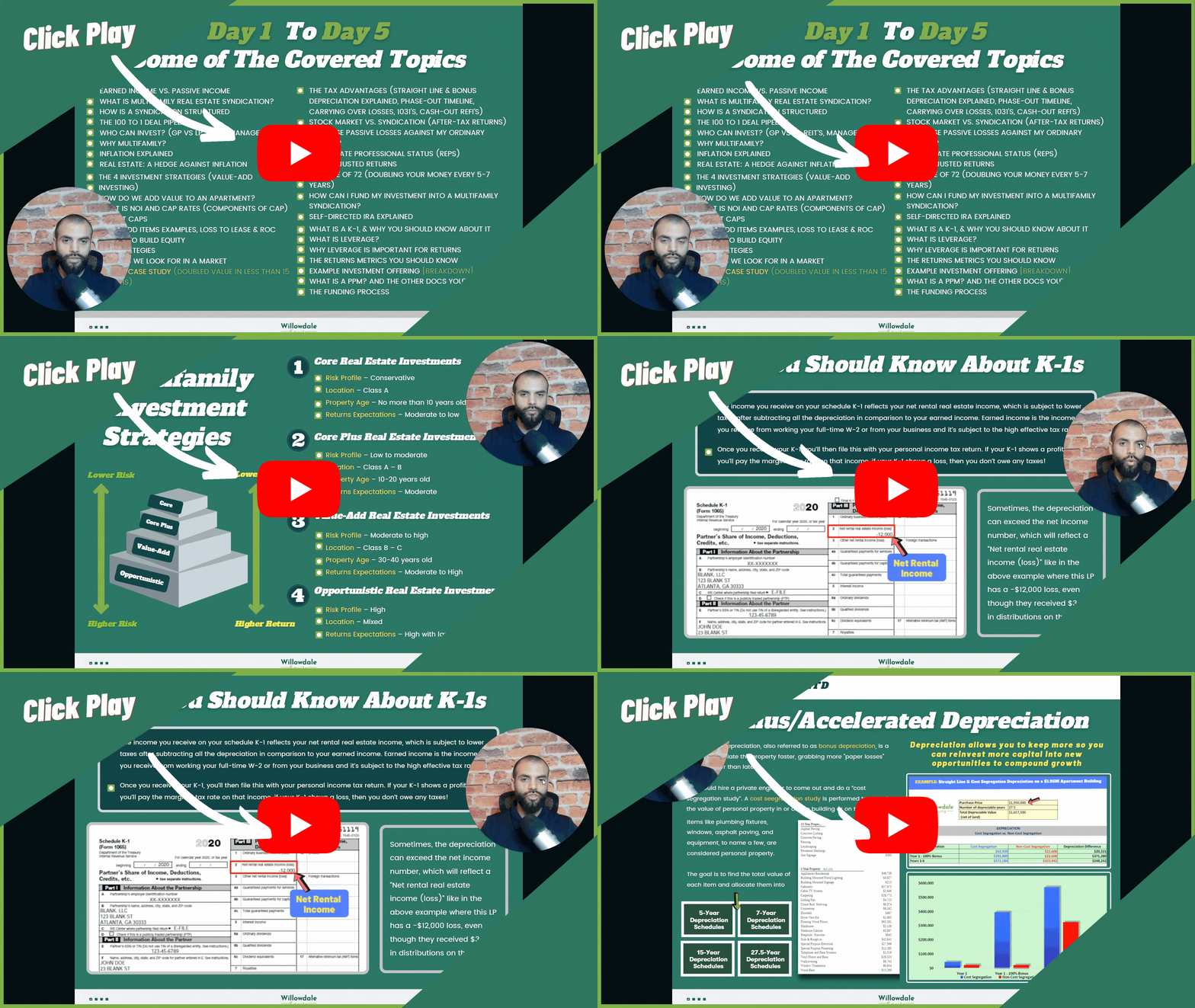
Free 5-Day Video Course
Everything you need to evaluate passive multifamily — in five short videos.
Five 7 a.m. emails over five mornings. Earned-vs-passive income, syndication mechanics, K-1 tax treatment, market cycles, and underwriting — no credit card, no sales pitch.
Get Instant Access →Free. Unsubscribe with one click.
Evaluating and Selecting the Right Deals

Once a deal lands in front of you and the sponsor has cleared your first-pass evaluation, the work shifts to the deal itself. The objective at this stage is not to second-guess every line of the underwriting — you don't have the operator's ground-level data — but to verify that the deal as presented matches the market reality, that the assumptions are defensible against publicly available data, and that the downside scenarios are survivable. The sponsor's job is to produce a model that hits a target return; your job is to figure out whether that return is achievable under realistic assumptions, and whether the structure protects your capital if it isn't.
Analyzing Market Conditions
Market conditions analysis at the LP level should focus on a small number of high-signal data points rather than trying to recreate the sponsor's underwriting. The first is population and migration: is the MSA gaining or losing residents, and what is the trajectory over the past three to five years (U.S. Census Bureau ACS data and UHaul/Atlas Van Lines migration reports are the standard primary sources). The second is employment: is the local job base growing, what are the wage trends, and how diversified is the employer mix (BLS QCEW data is the authoritative source). The third is supply: how many units are in the immediate submarket pipeline coming online over the next 12 to 24 months, and does the absorption math pencil under conservative concession assumptions (RealPage, Yardi Matrix, and Marcus & Millichap publish pipeline data).
Cycle stage matters at least as much as the point-in-time data. Glenn Mueller's market cycle quadrant model — used widely in institutional underwriting — classifies submarkets across Expansion, Hypersupply, Recession, and Recovery. Deals that work in Expansion phases (rising occupancy, accelerating rent growth, limited new supply) do not necessarily work in Hypersupply (new deliveries outpacing absorption, concessions reappearing, rent growth softening). At Willowdale, we've passed on multiple deals that looked attractive on price alone — including a 180-plus-unit deal in early 2024 priced in the low-6% cap range where the immediate submarket had several thousand units in the pipeline coming online over the following 18 months. The absorption math didn't pencil under conservative concession assumptions, so we walked. As an LP, you don't have to do that volume of work, but you do need to ask the sponsor where the submarket sits in the cycle and what evidence supports that assessment.
Understanding Financial Metrics
The financial metrics LPs need to internalize for syndication evaluation are a small set, and they each answer a different question. The preferred return (typically 7–9% cumulative-and-compounding) tells you what minimum yield you receive on capital before the sponsor earns anything beyond fees — this is the LP-protective floor of the structure. The equity multiple (cash distributions plus capital return, divided by capital in) tells you the total dollars-on-dollar outcome over the hold. The IRR tells you the time-weighted return, which is what most sponsor underwriting headlines. Cash-on-cash yield in the early years tells you how much current income to expect before any refi or sale event hits.
Sponsor co-invest is one of the most commonly misunderstood metrics at the LP level. The textbook advice is “look for sponsors with skin in the game,” and the assumption is that higher sponsor co-invest signals better alignment. The operating reality is more nuanced. Lenders — both agency (Fannie Mae, Freddie Mac) and most banks — require the sponsor principal to maintain liquidity equal to roughly 10% of the loan balance on each closed deal in order to qualify for new debt and to remain compliant as guarantor on existing loans. Sponsors who over-commit their own cash into individual deals lose the liquidity they need to service those guarantor obligations and to close the next acquisition — which is the structural reason most experienced multifamily sponsors operate with disciplined limits on per-deal cash co-invest rather than maximizing it. The LP-side question is therefore not just “did the sponsor put in cash” but “is the sponsor's earned promote and asset-management economics genuinely aligned with LP outcomes, and what is their lender liquidity-reserve posture telling you about the discipline they bring to debt management more broadly.”
Frequently Asked Questions About Finding Real Estate Syndications
What are the steps to locating profitable real estate syndication opportunities?
The honest step-by-step is: (1) decide what asset class you want exposure to and what hold period and check size you can commit to, (2) identify 5 to 10 sponsors with strong track records in that asset class who raise from accredited investors, (3) get onto their investor lists through their websites or direct outreach, (4) read their market commentary and attend their webinars for a few months before evaluating a specific deal — this is the warming period that gives you a real feel for how each sponsor thinks and reports, and (5) when a deal lands, run sponsor diligence first and deal diligence second. Most LPs who shortcut step 4 end up subscribing to deals from sponsors they don't actually know well — and that's where the worst LP outcomes typically originate.What criteria should an investor consider when evaluating real estate syndicates?
Sponsor diligence dominates: full-cycle track record (closed and exited deals, not paper IRRs on current holds), lender relationships and recourse posture, operational discipline (do they verify actuals or underwrite to broker pro formas), transparency in LP reporting frequency and depth, and alignment of incentives through fee structure and promote design. Deal diligence is secondary but specific: market cycle positioning, supply pipeline survivability, debt structure (fixed vs. floating, agency vs. non-agency, maturity-to-hold match), capital stack (any preferred equity sitting above the LP common), waterfall promote thresholds, and operating reserves including deferred-maintenance contingency on older-vintage assets. If the sponsor cannot speak to those dimensions in detail on a 30-minute call, that itself is diligence information.How does one become a member of a real estate investment syndicate?
The mechanical path is: meet the accredited investor threshold ($200,000+ income for two years, $300,000 joint, or $1 million+ net worth excluding primary residence), join a sponsor's investor list, wait for a deal that matches your goals to be offered, review the PPM and the offering documents, schedule a call with the sponsor to ask questions, complete the subscription documents (including accreditation verification under Reg D §506(c) or self-certification under §506(b) depending on the offering), and wire the capital. Most sponsors handle the entire workflow through a digital portal (Syndication Pro, Juniper Square, Cash Flow Portal) so the document signing, the K-1 delivery, and the distribution reporting all live in one place.Can you outline the benefits and risks associated with investing in real estate syndicates?
The benefits are real: monthly or quarterly distributions, depreciation flowing through on the K-1 (which can shelter a meaningful portion of cash distributions from current tax), exposure to institutional-quality real estate with $50,000 to $100,000 minimum check sizes, and no operational responsibility on the property. The risks are equally real: the equity is illiquid for the full 5- to 7-year hold (there is no secondary market), the LP's worst-case downside is loss of capital, the sponsor's execution drives almost all of the outcome variance, and the IRR projections in the PPM are projections — not commitments. The LP-protective features (preferred return, voting rights on major decisions, structural insulation from recourse) reduce but do not eliminate those risks. Sizing the position to a portfolio percentage you can afford to underperform is more important than picking the single highest-projected-return deal.What distinguishes real estate syndication deals from other types of real estate investments?
The key distinguishing feature is the separation of capital from operations. In a direct real estate purchase, the investor IS the operator — they manage the property, sign for the debt, and handle every operational decision themselves. In a public REIT, the investor owns a security and has no claim on any specific property — their return is correlated to the broader public-equity market. A syndication sits between those two: the LP owns a direct economic interest in a specific property, gets the K-1 tax treatment of direct ownership including depreciation pass-through, and has no operational responsibility. The hold period is typically 5 to 7 years, materially longer than the typical public REIT holding period but shorter than direct ownership horizons, and the entry minimum is much lower than buying a comparable property directly.How to Find Syndication Deals - Conclusion
Finding real estate syndication deals is largely a relationship process, not a search-engine process. The credible deals route through the sponsor's own investor list, through referrals from existing LPs, and through professional networks like LinkedIn — not through public crowdfunding aggregators, which by structure surface the deals that did not subscribe out through the relationship channel. The LP-side work is therefore upstream: identifying 5 to 10 sponsors worth a long-term relationship, getting onto their lists, and going through the warming period before any specific deal evaluation begins.
Once a deal lands, sponsor diligence matters more than deal diligence — and within sponsor diligence, the dimensions that actually predict outcomes (track record on full-cycle deals, lender relationships, operational discipline, reporting transparency) are different from the metrics most LP-facing marketing emphasizes. The financial mechanics of a syndication each answer different questions and need to be evaluated together rather than treated as a single ranking signal. The most commonly misunderstood metric — sponsor co-invest — is constrained by lender liquidity requirements, which means a near-zero cash co-invest is often a structural lender constraint rather than a misalignment signal.
The LPs who do well in syndications over multiple deals tend to be the ones who treat sponsor selection as the primary decision and individual deal selection as the secondary one — building long-term relationships with two or three operators they trust, deploying through those operators across multiple deals over a decade, and using each new deal as additional evidence rather than as a one-off bet. That posture takes longer to develop than a single deal subscription, but it is also the posture that consistently produces the best LP outcomes across cycles.
Sources
- Investor.gov — Private Placements under Regulation D – Updated Investor Bulletin
- SEC — Private Placements - Rule 506(b)
- SEC — General Solicitation — Rule 506(c)
- Cornell Law — Regulation D (Wex Legal Encyclopedia)
The Yield Brief
Start your Tuesday with the moves that matter.
Join 2k+ subscribers for a weekly read on multifamily markets, rates, policy, and the moves accredited investors are actually making.
No spam. Unsubscribe anytime.

Daniel Di Cerbo
Daniel is the Co-Founder and Principal of Willowdale Equity, a private real estate investment firm specializing in Class B & C value-add multifamily assets across the Southeastern U.S. He has been a sponsor on over $150M of multifamily acquisitions across Georgia and Texas.
Willowdale Equity content follows strict guidelines for editorial accuracy and integrity. Learn more about our editorial guidelines.